Chapter 1: Overview of Tera Calculation
Introduction
In February 2021, amidst the raging COVID-19 pandemic, I celebrated my 71st birthday. In August of the previous year, partly due to the impact of COVID-19, I decided to suspend the consulting business I had been running for over a decade, and began developing the new "Tera Calculation" software and creating this website.
Looking back, my career has been entirely dedicated to work related to 'distribution centers'—spending 20 years at a logistics equipment manufacturer, 10 years at a logistics operations company, and over a decade as an independent consultant. During my time at the logistics operations company, I gained experience in logistics consulting under the late Mr. Mutsumi Nakanishi. Later, I received guidance from the late Mr. Shin Suzuki on the logistics analysis method known as 'EIQ Analysis.' When I became independent, I was blessed with the opportunity to take over Mr. Suzuki's consulting firm, the 'Logistics Technology Research Institute.
The 'motives' and 'policies' that led me to create this website and release the software are as follows.
Motives for Creation
1. To supplement the 'lack of explanation' in a co-authored book
Invited by Professor OO, I participated in monthly study group meetings
over the course of 4 to 5 years, eventually joining as one of the co-authors
of "Logistics OO" (published last April by the OO Institute).
At the time of writing, Professor OO encouraged me, saying, "Space
is limited, so condense what you want to say to the core, and save what
you couldn't write for another opportunity," allowing me to somehow
complete my part. However, in the section I was responsible for, "How
to Estimate Distribution Center Scale from Shipping Data," there remained
an undeniable lack of explanation between the lines. I had a strong desire
to properly supplement this in my own words
2. As a 'baton runner' inheriting the will of my mentor
Last June, Mr. Shin Suzuki, who desired the spread of EIQ analysis more than anyone else, passed away. As someone who was taught by him, feeling a sense of mission to become a baton runner and leave behind writings on EIQ analysis was also a major driving force.
Policy for Creation
A culmination not of 'orthodox theory,' but of proprietary calculation software grounded in actual practice
When creating this, I struggled greatly with how to explain the EIQ method. This is because some of my ideas and calculation methods might not align with Mr. Suzuki's intentions. After agonizing over it, I concluded that I would leave the academic 'orthodox EIQ method' to others. I choose to compile the calculation methods I have actually used in field 'practice.' I will provide you with a practical "Tera Calculation" software, an original calculation program that incorporates traditional calculation methods without being strictly bound by rigid EIQ methodology.
(Written in February 2021)
- 2021Software configuration review
- April 2022Creation of prototype versions for Tera Calculation 0 (Data Processing), Tera Calculation 1 (Analysis & Aggregation), and Tera Calculation 2 (Distribution Center Scale Calculation).
- Since 2022"Tera Calculation (Prototype Version)" is being used at two universities.
- 2023Creation of Tera Calculation 3 (Utility Software for Logistics Equipment Installation Area Calculation) and logistics system-related programs.
- 2024Intermittently suspended due to poor health.
- August 2025Started creating the website.
- January 2026Started development of Tera Calculation EIQQ_AI software.
- July 2026Completed the prototype of Tera Calculation EIQQ_AI software, provided to 2 universities.
Note: The names of the individuals and organizations cannot be displayed as we have not obtained permission to publish them. Please wait for further updates.
Section 1: Software Creation Philosophy
"The mission of a distribution center is to protect the customer's lead time and ship products.
Inventory exists for the purpose of shipping, and receiving exists to secure that inventory.
Therefore, 'shipping data' is the foundation that determines the scale and functions of a distribution center.
Any increases or decreases in inventory and receiving due to sales or purchasing convenience should simply be added after calculating the distribution center scale based on the 'shipping data'."
Tera Calculation was developed based on the essential role of a distribution center and the importance of data. Its core concepts are as follows:
- Mission of the Distribution Center: To protect the customer's lead time and ship reliably.
- Priority in the Flow of Logistics: Inventory exists "to be shipped," and receiving is performed "to secure inventory."
- Foundation for Design: Therefore, "shipping data" is the sole basis for determining the scale and functions of a distribution center.
- Handling Variable Factors: Increases or decreases in inventory/receiving due to sales or purchasing convenience should be considered as additive factors only after the basic scale has been calculated based on the "shipping data."
Section 2: Purpose of Tera Calculation
The Tera Calculation software is an educational software designed to teach the methods and procedures from analyzing shipping data to calculating the scale of a distribution center.
- Consistent Learning Environment: To prevent results from fluctuating with each calculation, modification of shipping data is prohibited, and input values are fixed (Tera Settings).
- Consideration for Beginners: Includes basic data and detailed explanations so that even those unfamiliar with distribution center mechanisms can understand.
- Prospects for a Practical Version: By removing educational restrictions and allowing customizable settings, it is envisioned as a practical tool useful for detailed condition extraction, layout planning, current status analysis, and improvement.
Section 3: Positioning of Tera Calculation
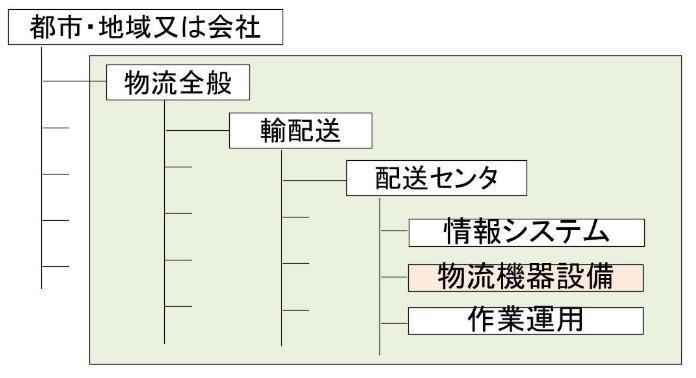
The system design of a distribution center can be broadly divided into three areas, but Tera Calculation is software specialized in the "Equipment and Facility System" among them.
- Equipment and Facility System (Applicable Area of Tera Calculation): Calculates the required area and equipment scale of the distribution center.
- Close Relationship between Commercial Flow and Logistics: Logistics is a world where the decisions of other departments (the commercial flow side) are directly reflected. It is in a position where it cannot independently adjust receiving/shipping volumes or inventory levels based on purchasing volumes or sales performance, but is instead influenced by them.
Section 5: About Tera Settings
Designing a logistics facility requires an enormous amount of data, but the Tera Calculation software adopts a unique input assistance system so users can smoothly begin their analysis.
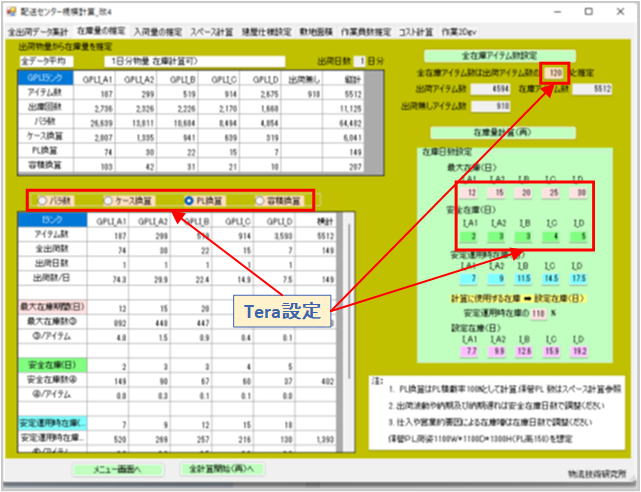
- Eliminating the Hurdle of Input Items: Originally, calculating the scale of a distribution center requires over 300 input items. However, when the software starts, temporary numerical values (Tera Settings) are pre-assigned to all input items.
- Improving Accuracy through Customization: The numbers in the Tera Settings can be arbitrarily modified, and the changed numbers are reflected in all recalculations in real time.
Section 6: Tera Calculation Configuration
This software consists of three stages: data processing, analysis, and simulation (Tera Calculations 0 to 2).
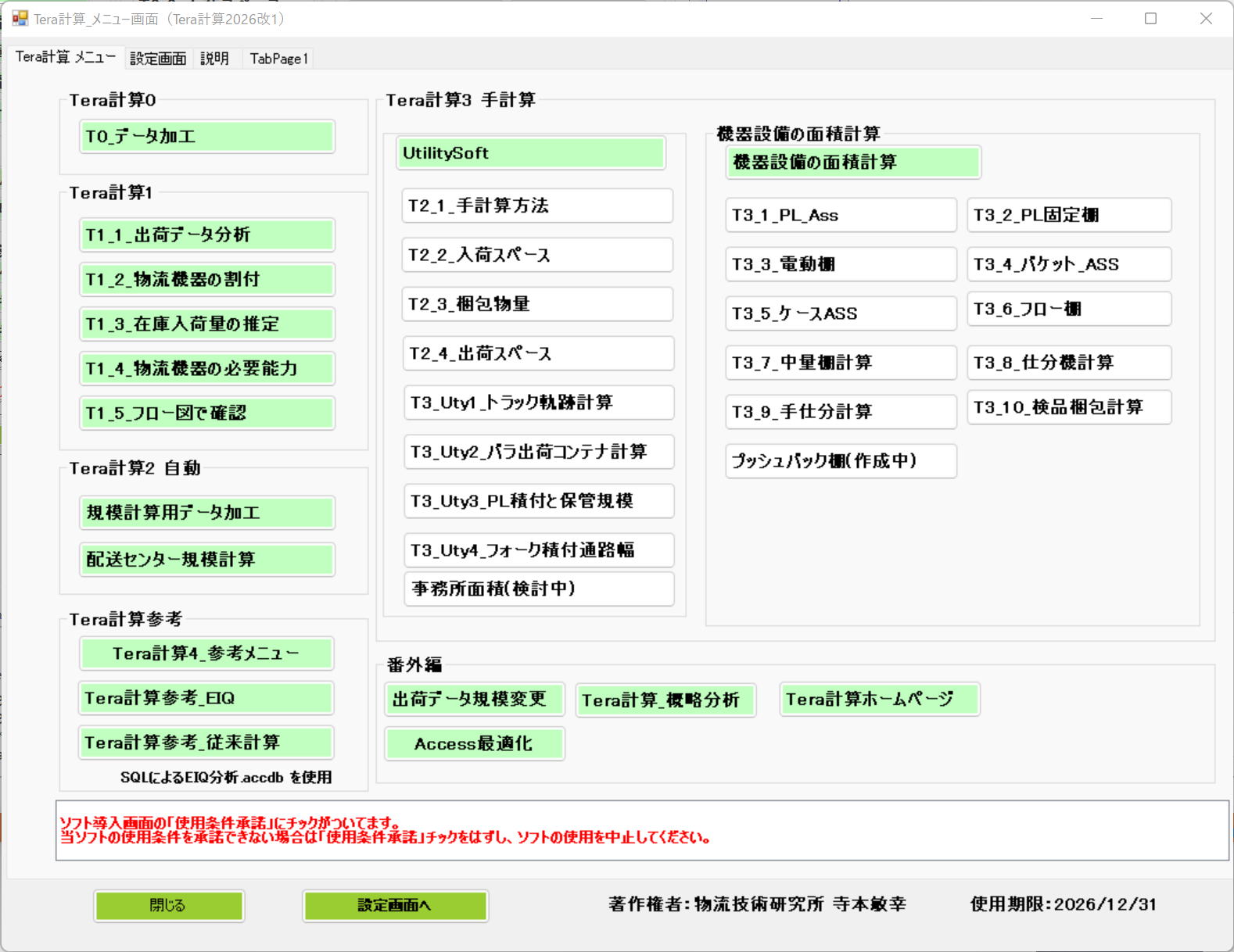
- Tera Calculation 0 (Shipping Data Processing): Processes shipping data and stores/maintains common data used for calculations in the "T200" table of Access.
- Tera Calculation 1 (Shipping Data Analysis & Equipment Allocation): Based on the "T200" table, classifies shipping ranks into 25 segments using EIQ Analysis, allocates equipment and facilities, and calculates the required scale.
- Tera Calculation 2 (Center Scale & Site Area Calculation): Estimates receiving and inventory volumes, and automatically calculates 40 patterns of building scales based on Tera Settings.
Section 7: Languages Used, Conditions of Use, and Installation Method
To process large volumes of shipping data (approx. 60,000 rows) at high speed, the Tera Calculation software is built combining database technology and programming languages.
- System Requirements and Development Language: The OS runs on Windows 11 (64Bit). VB.Net is used for screen display and calculation processing, while ADO.NET / SQL and Microsoft Access are used for analytical aggregation.
- Value of Mock Shipping Data: The bundled data is "mock shipping data," finely tuned based on data from an electrical parts wholesaler from 20 years ago, carefully adjusted to ensure there are no discrepancies with actual operational centers while considering confidentiality.
Section 8: Installation Method
This section details how to install the Tera Calculation software.
1. Advance Preparation and System Requirements
Before starting the installation, the following environment must be prepared.
- Antivirus Software Compatibility: Antivirus software like Windows Defender may block the installation, so a temporary disablement might be necessary.
- Required Components: You must obtain and install the "Microsoft Access Database Engine 2010" and ".NET Framework 4.8" from Microsoft's website.
- Presence of Access Software: This software operates even if Microsoft Access is not installed, but you cannot directly view database tables without it.
2. Installation Procedure
The actual installation follows the flow below.
- Executing Setup: Launch "setup.exe" located inside the distributed "Tera Calculation Inst" folder. This will automatically start the installation.
- Confirming the Installation Destination: The program is saved in a specific directory within the user profile (C:\Users\Username\AppData\Roaming\...).
- How to Launch: After completion, the software can be started by clicking "Tera Calculation_Menu Screen" displayed in the Windows menu under "Recommended" or similar sections.
3. Data Placement (Important)
To operate the software normally, careful attention to data placement is required.
- Copying "Tera Calculation Data": Copy the attached "Tera Calculation Data" folder to the root directory of any drive (e.g., D:, E:, F:).
- Prohibition of Duplicates: Copying the same folder name to multiple drives on the same PC will cause an error upon startup. If placing it in multiple locations, you must change the directory name (e.g., "D:\Tera Calculation Data Copy").
- Automatic Recognition: If placed correctly, the software will automatically recognize the data.
4. Notes and Disclaimers
- Troubleshooting: Users are fundamentally expected to resolve installation issues themselves. It is recommended to back up the OS drive (C drive) beforehand.
- Distribution Status: Currently, it is distributed only to specific collaborators, and the scope and method of future distribution are under consideration.
Section 9: Regarding Software Distribution
We will explain the distribution status of the Tera Calculation software.
1. Software Distribution Status
The current provision status of the Tera Calculation software is as follows.
- Distribution Target: Currently, distribution is limited only to specific collaborators.
- Future Plans: The scope and specific methods of distribution to the general public are currently under consideration.
2. Towards Learning EIQ Analysis and Distribution Center Design
This software has an aspect of an educational tool to learn the procedures for calculating the scale of a distribution center from shipping data. While waiting for distribution, reviewing the following logic explained in the previous sections will enable a smooth introduction.
- Shipping Data is the Foundation of Design: The scale of a distribution center, which absorbs the changes in commercial flow (purchasing/sales), is entirely derived from shipping data.
- Utilization of EIQ Analysis: Optimal material handling equipment (automated warehouses, mobile racks, etc.) is selected through matrix analysis of the Entry (Destination), Item, and Quantity.
- Flexibility of Simulation: Dynamic calculations are possible, such as balancing 40 patterns of building specifications and site areas.